

Quick answer: Replit, Lovable, Bolt, v0, and App9 all help people build with prompts, but they are not interchangeable. The right choice depends on whether you need a cloud IDE, a Supabase-backed app, a fast browser prototype, a Vercel/Next.js workflow, or a simpler path from idea to hosted public app.
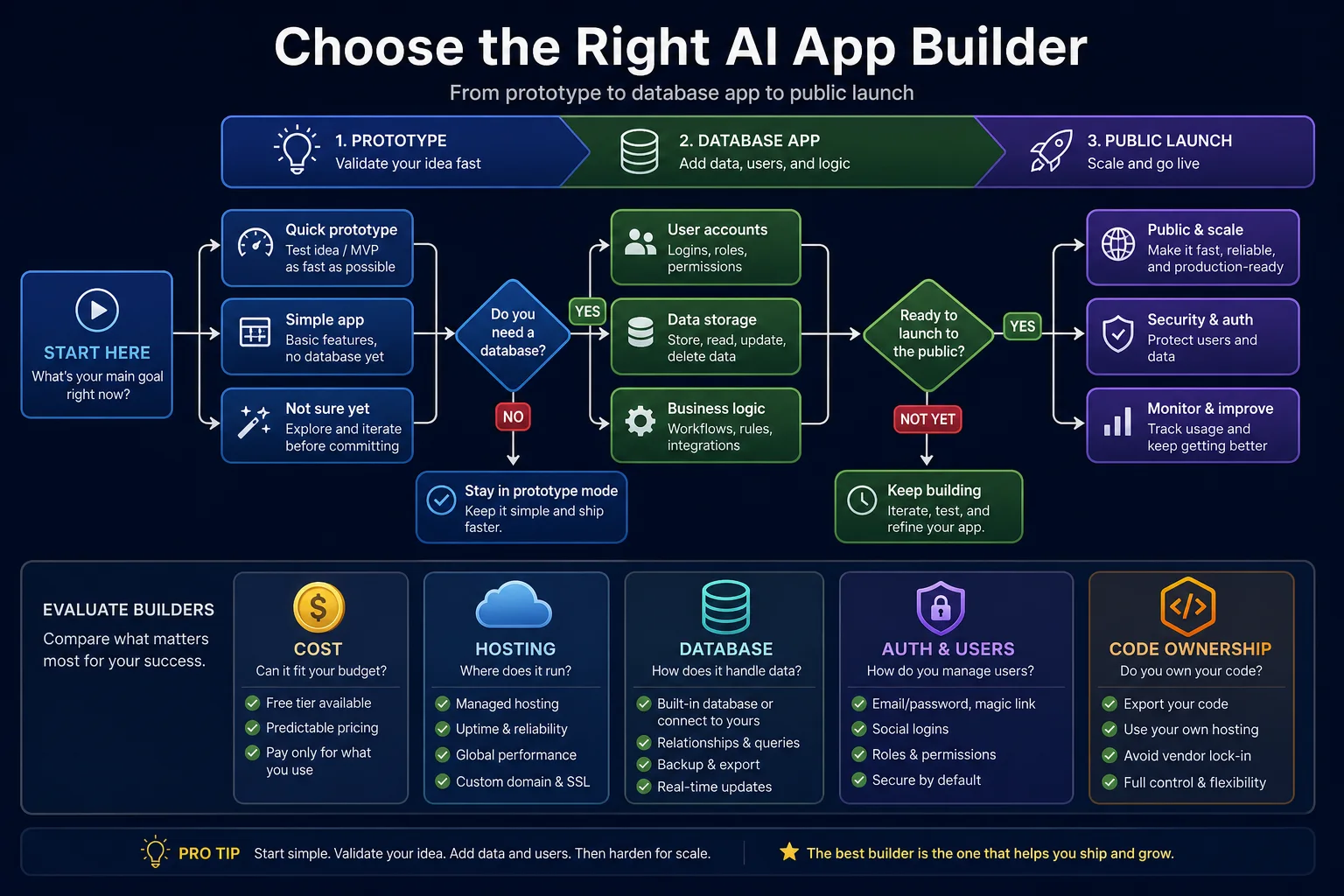
The comparison that matters: what happens after the demo?
Most AI app builders can produce a convincing first screen. The harder question is what happens when you need persistent data, login, deployment, custom domains, usage limits, cost control, and changes after launch. Community threads about no-code and vibe-coding tools repeatedly point to this “after the prototype” gap.
Decision matrix
| Tool | Best fit | Backend path | Launch/cost watch-out |
|---|---|---|---|
| Replit | People who want an AI-assisted cloud IDE and publishing workflow | Replit storage/database options; production databases have usage-based billing | Published apps can involve outbound data transfer, compute units, requests, and production database usage |
| Lovable | People who want chat-driven full-stack React apps with Supabase | Supabase integration for auth, database, storage, and functions | Credits matter; Supabase setup may still involve reviewing and running SQL |
| Bolt | Fast browser-based prototypes and app demos | Depends on selected stack/integrations | Token budgeting and team plan details matter for heavy iteration |
| v0 | Next.js, React, Tailwind, shadcn/ui, Vercel-oriented workflows | Works well with GitHub/Vercel projects, env vars, domains, and deployments | Best full experience is tied to a Vercel project |
| App9 | People who want to describe and launch public web apps with less separate hosting/database setup | App9.co handles the builder and hosted-app workflow | Best for users who value integrated launch flow over manually assembling a custom stack |
Replit: strongest when you want a real cloud workspace
Replit’s publishing docs describe a workflow for sharing apps publicly, choosing deployment types, using custom domains, monitoring, analytics, access controls, and feedback collection. Its billing docs also make clear that published apps can involve usage categories such as outbound data transfer, compute units, requests, and production database usage. That is powerful, but beginners should understand the moving pieces before assuming the prototype cost is the production cost.
Lovable: strongest when Supabase is the right backend
Lovable’s own docs position Supabase as the path for authentication, database tables, storage, real-time features, and serverless functions. That can be excellent for full-stack apps, especially if you want PostgreSQL underneath. The practical point for beginners: even when the AI helps, you still need to understand what data the app stores and how that data should be structured.
Bolt and v0: fast iteration, different centers of gravity
Bolt is attractive for fast in-browser building and demos, with paid plans tied to token allotments and rollover rules. v0 is especially relevant when your target stack is Next.js, React, TypeScript, Tailwind, and shadcn/ui. v0’s FAQ says Projects are connected to real app settings such as deployments, environment variables, and domains, while Folders are just organization. That distinction matters once a chat becomes a real app.
Where App9 fits
App9.co is positioned for people who want to describe an app and get to a hosted public result without separately learning a code editor, a deployment provider, a database dashboard, and a domain workflow all at once. App9.org is where public-facing App9-made apps and examples can live.
Pick by the bottleneck, not the brand
The best builder is the one that removes your current bottleneck. If your bottleneck is code editing, Replit may feel natural. If your bottleneck is turning a prompt into a database-backed interface, Lovable plus Supabase may be attractive. If your bottleneck is rapid visual iteration, Bolt or v0 may be faster. If your bottleneck is getting from idea to hosted public web app with fewer separate services, App9 is the more relevant comparison.
Three cost questions to ask before choosing
- What is metered? Look for credits, tokens, requests, bandwidth, compute, storage, database usage, and collaborators.
- What happens when the app is public? Prototype usage and real-user traffic are not the same cost pattern.
- What services are separate? A separate database, deployment host, analytics tool, and auth provider can be powerful, but each adds a billing and setup surface.
Three production questions to ask before choosing
- Can I inspect and change the app after generation? AI output is only useful if you can keep improving it.
- Where does user data live? The answer should be explicit before people enter real information.
- How do I recover from a mistake? Look for version history, deployment rollback, database backup, or at least a clear manual recovery path.
Best-fit recommendations
| If you are… | Start by evaluating… | Why |
|---|---|---|
| A developer who wants AI help inside a workspace | Replit | The cloud IDE model keeps code and runtime close together. |
| A founder who wants a polished full-stack app quickly | Lovable | The Supabase path is strong when database-backed apps are the goal. |
| A creator testing a visual idea | Bolt or v0 | Both are strong for rapid interface iteration. |
| A non-developer trying to launch a useful public app | App9 | The integrated builder-to-hosted-app path reduces setup surfaces. |
FAQ
Is “vibe coding” enough for a real app?
It can be enough for a useful first version, but not if you ignore data, auth, costs, and maintenance. Treat the AI-generated prototype as a strong starting point, not the end of the product work.
Should beginners pick the most powerful tool?
Usually no. Beginners should pick the tool that makes the next decision clearer. Too much control can be another form of complexity if the user mainly wants to launch a useful public app.
Bottom line
Choose Replit if you want a cloud development environment. Choose Lovable if Supabase-backed React apps fit your mental model. Choose Bolt for fast browser prototypes. Choose v0 when your target is a Vercel/Next.js-style app. Choose App9 when your priority is a simpler builder-to-public-app path.